Bio-methanol
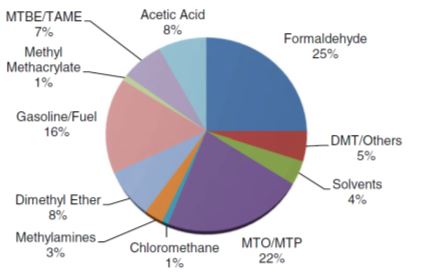
Methanol is a simple alcohol with the formula CH3OH. It has many uses, such as fuel for combustion to generate heat and/or electrical energy, fuel for vehicles and as solvent and feedstock for the generation of other chemicals. In 2015 the total demand of methanol was 70 Mt. The different areas of demand are shown in figure below. Of these, methanol-to-olefins (MTO) and formaldehyde are the most common products.
The production of methanol is well established. It became more prominent in the 1960s when Imperial Chemical Industries (ICI) developed a low-pressure methanol (LPM) process that allowed for mild reaction conditions [9]. For this process the feed for the reactor is syngas, a gas consisting of carbon dioxide (CO2), carbon monoxide (CO) and hydrogen (H2).
Syngas can be produced from different feedstocks. The main feedstock is natural gas. Natural gas can be converted to become syngas through steam reforming and/or auto-thermal reforming and through partial oxidation. However other sources such as coal, higher hydrocarbons and biomass can be used as well.
Using biomass as the feedstock for syngas has various advantages. The main advantage is the potentially carbon-neutral product, as the carbon stored in biomass has been captured from the air. Some main disadvantages are in the many cleaning steps that are required to avoid poisoning of the catalysts, the storage of the biomass before processing and the transport of the biomass to the production plants.
The disadvantage of transportation comes from the biomass’ low energy density and long transport paths before it arrives at the production plant.
One solution is a pre-treatment closer to the area where the biomass is sourced. This pre-treatment increases the energy density and thus reduces the amount of fuel needed for transportation.
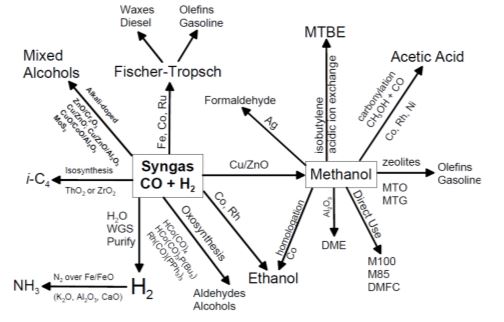
Biomass can be gasified to syngas, or it is available from digesting of waste waters polluted with organic substances. in both cases the route from syngas to methanol is the same. Many other products can be produced as shown in below diagram.
The prevailing technology for producing methanol is the low-pressure atalytic reaction of syngas.
The low pressure allows for operating conditions which favour the conversion of methanol and nearly completely inhibit the production of by-products. This leads to a high selectivity of > 99 %. The most common catalyst used in low-pressure methanol production is a Copper-Zinc Oxide catalyst with Aluminium Oxide or Chromium(III) Oxide (Cu – ZnO – Al2O3/Cu – ZnO – Cr2O3).
The reactions relevant for the production of methanol have been known for long. Carbon dioxide and carbon monoxide can react with hydrogen to form methanol with water as a side-product.
Equations below show the stochiometry of these reactions and their reaction enthalpy.
