POME bio-gas to bio-methanol
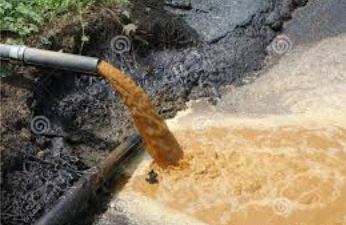
POME is a viscous liquid with a total evaporation residue (TS) content of 6-8%, an SS concentration of up to 3-4%, an oil content of 0.6-0.7% or more, a pH of 4-5, and a temperature of 80. -90 degrees Celsius, COD of up to 8-12 million mg / L, and contains a high concentration of K, Mg and other plant nutrients composed of dissolved salts. However, since no chemicals are added during the production process, POME does not contain chemical substances, which can be said to be a non-toxic high-concentration organic wastewater.
Photo 1: High concentration organic wastewater (POME) produced by palm oil plant.
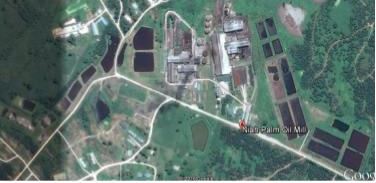
At present, more than 85% of the oil palm mill wastewater uses the traditional oxidation pond treatment technology that has been used for 100 years. Photo 2 is a satellite photograph of a typical palm oil mill. The typical oxidation pond treatment system for treating POME consists of a cooling pond, an acidification pond, an anaerobic pond and an aerobic pond. The hydraulic retention time is 3 days, 9 days, 36 days, and 18 days, respectively. The sewage is collected in the pond where it stays 66 days. The depth of the treatment pond is usually 2.5-10 meters.
Photo 2: Satellite photos of a typical oil palm oil mill (the ponds are the wastewater treatment facility.
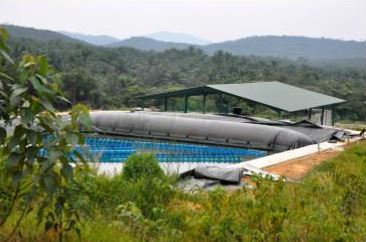
Ponds emit Methane , CO2 and H2S, through covering of the ponds with poly ethylene sheets (photo 3), these gases can be recovered and converted to heat, power or methanol.
Photo 3: Biogas recovery plastic film covering the anaerobic pond.
However methanol and fertiliser production can be optimized by treating the POME in mesophilic(36 °C) digesters with a typical biogas composition of CH4 68% and CO2 28 % and H2S 850 ppm , an ideal feedstock to produce methanol.
This digester replaces the ponds by more compact installation as shown in photo 4.
Photo 4: Mesophilic anaerobic POME digester.
